
The issue with many virtual world platforms is that they have not been designed around educational pedagogy that supports teaching and learning.
Virtual Worlds for K-12 has changed all that. With rich immersive spaces where students can explore and create, imagination takes a primary role in the learning process. Utilizing a custom avatar tool, students are able to take a critical role in creative projection, identity assumption, and role playing in the educational process.
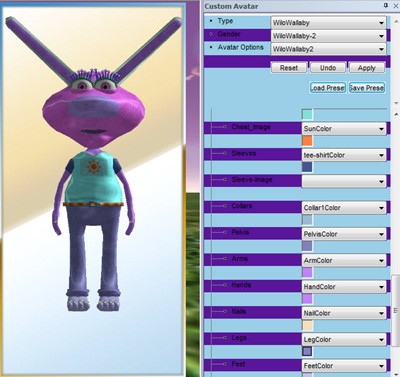
It’s important to give students the ability to create and customize avatars and to take an active role in the development of content and the ever-evolving storyline of the virtual world itself.
Many emerging virtual worlds for education are overlooking this fact and are just creating static pre-created immersive spaces that students travel through to do educational activities. Although these kinds of worlds have their places in education, K-12 Virtual Worlds pedagogy makes a beeline in the other direction and moves towards the highest levels of creativity and higher order thinking.
Our virtual worlds allow students to express a very a basic human need – the need to pursue variety, to push the envelope, to advance and to create.
In a closed, pre-made virtual world where everything has already been created, the world is the imagination and creation of the people who created it. K-12 Virtual Worlds allow students to contribute to the environment, which in turn allows student ideas to flourish. It brings back the “look what I made!” excitement to learning.